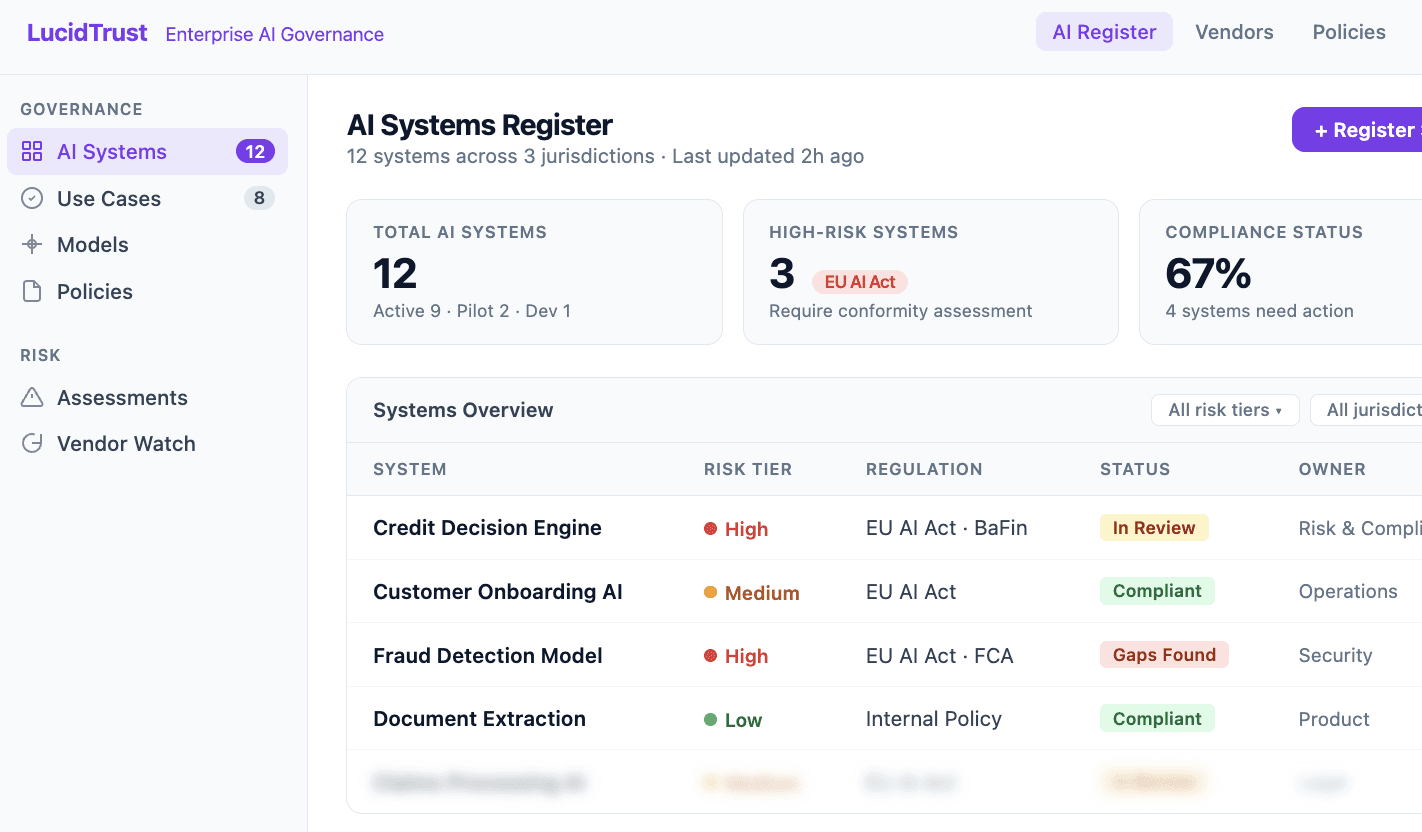
LucidTrust is an AI governance platform that helps regulated institutions discover, approve, monitor, and prove every AI system, vendor, model, agent, and use case before risk becomes audit exposure.

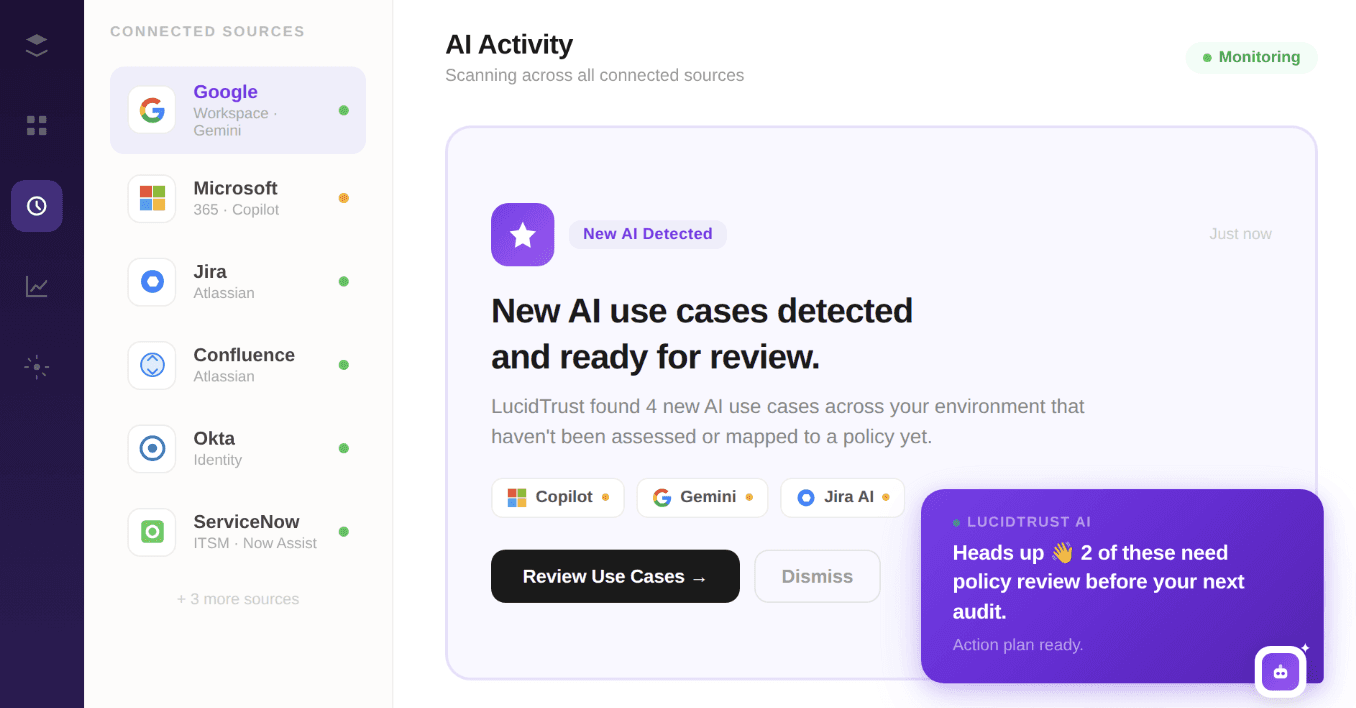
The new AI governance gap
You do not know every place AI is running.
AI use is scattered across business units, vendors, workflows, and internal tools. Without a central register, risk teams are forced to govern what they can see, not what actually exists.
Your vendors keep changing.
New AI features, models, data policies, and default settings can change your risk profile after onboarding. Annual reviews cannot keep up with weekly product releases.
Manual review is too slow.
Spreadsheets, intake forms, and quarterly committee meetings were not designed for AI that evolves continuously.
Regulatory expectations keep evolving.
Teams need to map AI systems, document oversight, assess risk, monitor change, and show evidence across frameworks and jurisdictions.
Audit readiness is still manual.
If an examiner asked tomorrow, most teams would scramble to prove what was reviewed, who approved it, what changed, and what controls are in place.

Mani Massoomi
Chief Risk Officer, Mercury
The LucidTrust platform
AI Inventory & Discovery
Find and track AI systems, vendors, models, agents, use cases, owners, and risk attributes.
Explore AI Inventory & Discovery
AI Vendor Monitoring
Monitor vendor AI changes, including new features, model updates, privacy shifts, and risk signals.
Explore AI Vendor Monitoring
AI Vendor Due Diligence
Assess AI vendors with instant AI discovery, risk, privacy, security, and governance context.
Explore AI Vendor Due Diligence
AI Use Case Governance
Review, approve, monitor, and document AI use cases with consistent risk-based oversight.
Explore AI Use Case Governance
AI Agent Governance
Govern AI agents by tracking permissions, actions, data access, controls, and human oversight.
Explore AI Agent Governance
Model Inventory & Risk
Manage model records, ownership, risk attributes, validation status, monitoring, and evidence.
Explore Model Inventory & Risk
AI Governance Workflows
Route AI intake, reviews, approvals, exceptions, reassessments, and follow-up across teams.
Explore AI Governance Workflows
Audit-Ready Reporting
Generate evidence showing what exists, what changed, who reviewed it, and what actions followed.
Explore Audit-Ready Reporting
Integrations
Connect AI governance to vendor, identity, workflow, documentation, GRC, and security systems.
Explore Integrations
1
Discover
LucidTrust helps identify AI systems, vendors, models, and use cases across your organization and connected workflows.
2
Classify
Each item is structured by owner, business purpose, data sensitivity, risk tier, jurisdiction, and review status.
3
Review
Teams route approvals, assign tasks, document decisions, and escalate high-risk cases through defined workflows.
4
Monitor
LucidTrust continuously monitors vendors and AI-related changes that could affect risk, compliance, privacy, or oversight.
5
Prove
Every review, decision, change, and action is captured in an audit trail so teams can report with confidence.
See LucidTrust in Action
Spreadsheets
LucidTrust gives you a living system of record instead of a static tracker that goes stale the moment a vendor, model, or use case changes.
Traditional GRC
LucidTrust adds purpose-built AI inventory, monitoring, workflows, and reporting that work alongside your existing GRC environment.
Vendor reviews
LucidTrust monitors AI vendor changes continuously so risk teams know when something materially changes after onboarding.
Policy-only
LucidTrust helps teams operationalize governance through intake, ownership, approvals, monitoring, evidence, and reporting.
Risk and Compliance
Know where AI is running, what risk it introduces, and what evidence exists to support oversight.
Legal and Privacy
Track data use, vendor terms, policy alignment, and regulatory obligations across AI systems and vendors.
Security and IT
Understand AI exposure across vendors, internal tools, connected systems, and employee adoption.
AI Governance Leaders
Give committees the process, visibility, and reporting needed to make governance operational.
Executives and Boards
Get a clear view of AI adoption, governance maturity, risk exposure, and progress over time.

Learn how regulated institutions can govern agentic AI with inventory, permissions, human oversight, audit trails, reassessment workflows, and evidence.
Agentic AI Governance: What Regulated Institutions Need Before AI Agents Go Live

Learn how regulated institutions can identify shadow AI, build visibility, route AI use into review, and maintain audit-ready AI governance evidence.
Shadow AI Risk: How to Find AI Use Across the Business

Use this AI vendor due diligence questionnaire to assess third-party AI risk.
AI Vendor Due Diligence Questionnaire Template
Explore Resources
How does LucidTrust work with our existing GRC platform?
LucidTrust is designed to complement your existing GRC environment by adding AI-specific inventory, monitoring, workflows, and reporting. Your GRC platform can remain the broader system for enterprise controls, while LucidTrust becomes the operating layer for AI governance.
Who is LucidTrust built for?
LucidTrust is built for regulated institutions and high-accountability teams responsible for AI oversight, including risk, compliance, legal, privacy, security, IT, and AI governance leaders.
What kinds of AI does LucidTrust track?
LucidTrust helps teams track AI vendors, AI-enabled software, internal use cases, models, business owners, data categories, risk tiers, approvals, and monitoring status.
How quickly can we get started?
LucidTrust is designed for lean teams that need useful visibility quickly. The goal is to help teams move from scattered tracking to a working AI governance system without a long implementation cycle.
What is the AI Governance Readiness Review?
It is a 30-minute working session designed to help regulated institutions identify governance gaps, prioritize what to fix first, and leave with a practical framework for the team, board, or next exam.